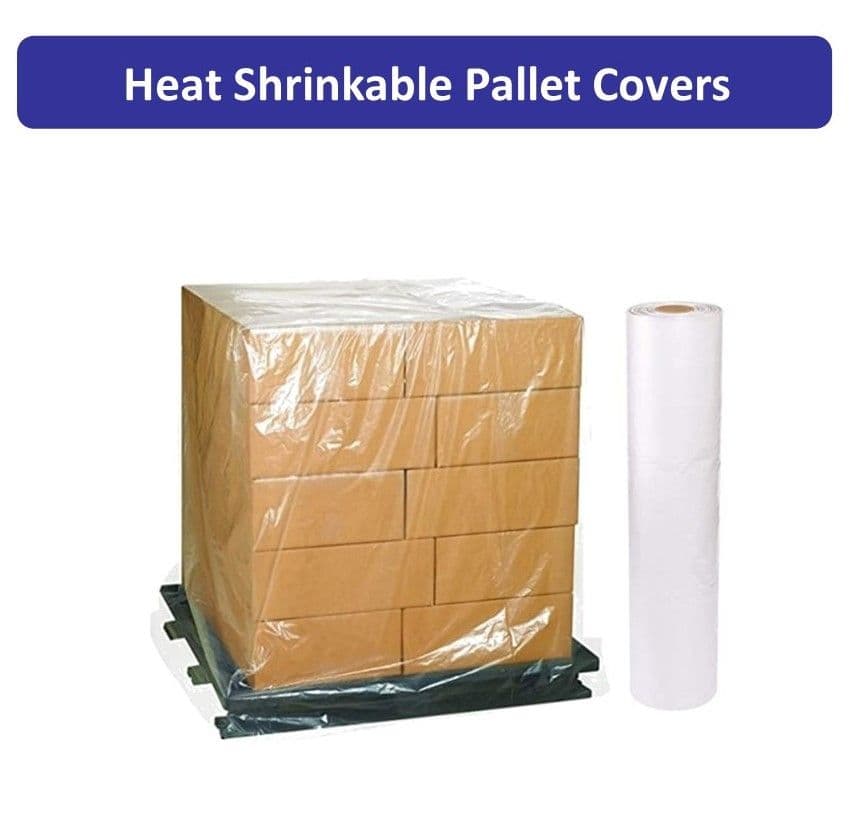
Heat Shrinkable Pallet Covers: Protecting Your Goods from Environmental Factors
Heat-shrinkable pallet covers provide a close-fitting outer layer around palletised goods. They are supplied as pre-formed covers that fit over the load before controlled heat is applied, causing the polythene to contract.
This can help protect products from warehouse dust, dirt and light moisture while keeping loose outer packaging contained. The covers are particularly useful for bulky or irregular loads that are difficult to wrap neatly with standard stretch film.
Martins Mill Packaging supplies heat-shrinkable pallet covers in five sizes for standard and Euro pallets.
How Do Heat-Shrink Pallet Covers Work?
The cover is placed loosely over a prepared pallet load. Suitable heat-application equipment is then used to shrink the film around the products.
As the material contracts, it forms a closer fit around the top and sides of the pallet. This differs from stretch wrap, which is pulled around a load under tension and does not normally require heat.
The completed covering can help:
- Keep dust and warehouse dirt away from products
- Reduce exposure to light moisture and splashes
- Contain loose outer packaging
- Protect cartons from everyday scuffing
- Create a tidier covering around irregular loads
The level of protection depends on the condition of the cover and how well it has been applied. Gaps, punctures and poorly sealed edges can allow moisture or dirt to reach the goods.
When Are Pallet Covers Useful?
Heat-shrinkable covers may be considered when goods need fuller coverage than ordinary stretch wrap provides.
Common applications include:
- Machinery and industrial equipment
- Furniture and bulky products
- Building materials
- Mixed cartons on standard pallets
- Irregularly shaped pallet loads
- Products stored in dusty warehouse areas
The film should not be applied directly over sharp corners or projecting components without suitable protection. These areas can puncture the cover as it contracts.
Heat-Shrink Covers and Pallet Wrap Compared
| Consideration | Heat-Shrink Cover | Stretch Pallet Wrap |
|---|---|---|
| Application | Placed over the load and heated | Stretched around the pallet |
| Top coverage | Covers the top and sides | Usually applied mainly around the sides |
| Typical loads | Bulky or irregular palletised goods | Routine cartons and stable pallet loads |
| Equipment | Suitable heat equipment required | Applied by hand, dispenser or machine |
| Speed | Requires fitting and controlled heating | Often quicker for everyday wrapping |
For routine warehouse work, pallet wrap may be the simpler option. Heat-shrink covers may be more appropriate where fuller coverage or a closer fit around an awkward load is required.
Do Pallet Covers Stabilise the Load?
A closely fitted cover can provide some containment, but it cannot make a badly stacked pallet safe.
Before applying the cover, check that:
- The pallet is sound and suitable for the load
- The weight is distributed evenly
- Cartons do not overhang the pallet unnecessarily
- Loose products have been contained
- Sharp edges have suitable protection
- The goods are stable before heat is applied
Some loads may also require strapping, edge protectors or other packing materials. The finished pallet must still be restrained correctly inside a delivery vehicle.
Are Heat-Shrink Covers Waterproof?
Heat-shrink covers can provide useful resistance to dust, dirt and light moisture, but they should not automatically be treated as completely waterproof.
Protection can be affected by:
- Open or poorly sealed edges
- Punctures caused by sharp products
- Damage during forklift handling
- Water collecting around the pallet base
- Long periods of outdoor exposure
Businesses planning outdoor storage should check whether the exact cover is suitable for the expected weather and duration. Products sensitive to moisture may require additional protection.
Condensation can also form inside plastic packaging when temperature and humidity change. The cover does not remove moisture already present in the goods or surrounding air.
Choosing the Correct Cover Size
The cover needs to fit over the full pallet load before shrinking, with enough material to reach the required point around the base.
Measure:
- The pallet length and width
- The total height of the loaded pallet
- Any products that project beyond the main load
- The additional space required for fitting
The current range includes covers designed for both standard and Euro pallets, with several load heights available. Do not choose solely according to the pallet base because the completed load height also matters.
A cover that is too small may split or place pressure on vulnerable products. An excessively large cover may create loose folds and require more heating to achieve a close fit.
Apply Heat Safely
Heat-shrink wrapping must be carried out using suitable equipment in an appropriate working area. Depending on the equipment, the process may involve high temperatures or a naked flame.
Before beginning:
- Follow the cover and equipment manufacturers’ instructions
- Complete an appropriate fire-risk assessment
- Keep flammable and combustible materials away
- Check that the goods are not heat-sensitive
- Provide suitable ventilation
- Make appropriate firefighting equipment available
- Make sure operators have received suitable training
Do not use heat near fuels, solvents, aerosols, gas cylinders or products that may release flammable vapours. Stretch wrapping may provide a safer alternative where heat cannot be used appropriately.
Can Heat-Shrink Covers Be Reused?
A cover may sometimes remain usable if it can be removed without cutting or damaging it, but reuse should not be assumed.
Before using a cover again, inspect it for:
- Holes and punctures
- Stretched or thinned areas
- Damage caused by previous heating
- Contamination from the earlier load
- Edges that can no longer be secured properly
A damaged cover may no longer provide the expected containment or protection. Products requiring consistent packaging are generally better served by a fresh, correctly sized cover.
Choose the Cover for the Load and Environment
Heat-shrinkable pallet covers offer a practical way to cover bulky and irregular palletised goods. They can reduce exposure to dust, dirt and light moisture while creating a closer outer layer than an unsecured cover.
They must still be matched to the pallet dimensions, applied safely and used alongside appropriate load-stability and transport measures.
Browse the wider pallet wrap and film range, or contact Martins Mill Packaging with the pallet dimensions, load height and intended storage conditions for help choosing a suitable cover.

Martins Mill Packaging
We are a Halifax, West Yorkshire based supplier of high quality industrial and commercial packaging, materials & solutions, providing local and national deliveries, and competitive pricing, and have been trading for over 20 years.