
What Is the Difference Between Cable Ties and Wire Ties?
Cable ties and wire ties are both used to secure, bundle and organise items, but they work in different ways. Choosing the right one depends on what is being fastened, how tightly it needs to be held and whether the tie must suit an irregular shape or sensitive surface.
A cable tie has a self-locking design that makes it quick to apply and difficult to loosen accidentally. A wire tie is wrapped around the item and twisted closed, either by hand or using a suitable tool.
Martins Mill Packaging supplies a range of cable and wire ties for packaging, warehousing, construction, landscaping and general commercial use.
The Short Answer
Cable ties are generally better for quick, neat fastening where the tie can remain closed until it is cut away. They are commonly used for cable management, lightweight bundling, stock organisation and temporary fixing.
Wire ties are often more suitable for closing sacks, securing flexible materials and tying irregular bundles. Their pliable construction allows them to be shaped around fabric, hessian, paper and plastic containers before being twisted closed.
Neither option is automatically stronger or more suitable for every application. The material, dimensions, tensile performance, environment and manufacturer’s specification should all be considered.
How Cable Ties Work
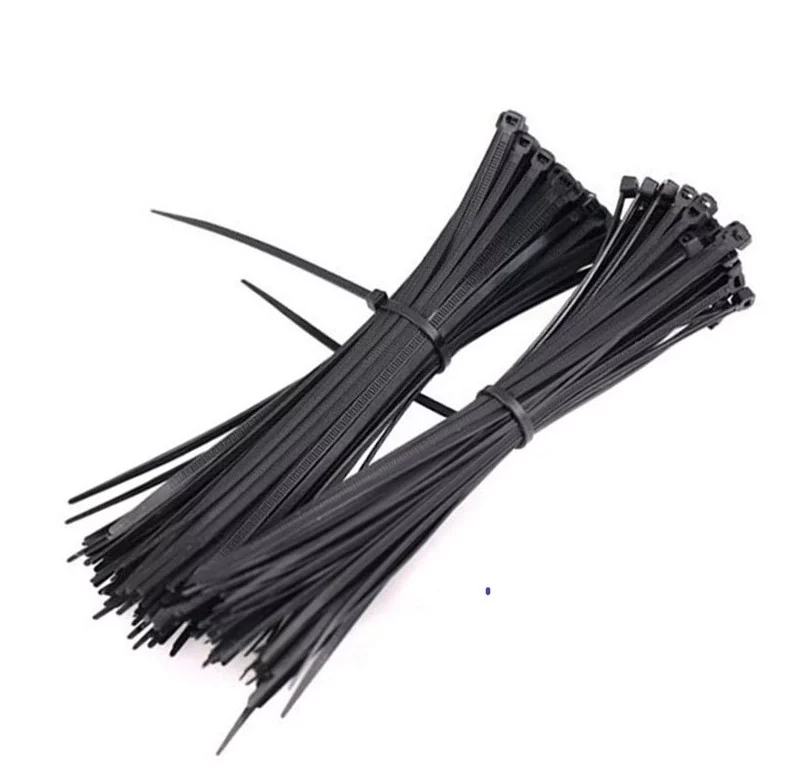
A standard cable tie consists of a flexible strap with ridges along one side and a locking head at one end. The free end is passed through the head and pulled until the loop fits around the item.
The locking mechanism engages with the ridges, preventing the strap from moving backwards. This creates a quick fastening that normally remains in place until it is cut.
Black self-locking nylon cable ties are available from Martins Mill Packaging in several sizes, with longer options also offered for larger bundles and fastening tasks.
Cable ties are commonly used for:
- Grouping cables and data leads
- Organising hoses and lightweight pipework
- Bundling small products and components
- Securing labels or temporary signs
- Holding protective materials in position
- General workshop and warehouse organisation
How Wire Ties Work
Double-loop wire ties have a loop at each end. The tie is wrapped around the item, the two loops are brought together and the wire is twisted until the required hold is achieved.
They can be closed by hand for occasional work. A pull-and-twist tool can make repeated application faster and provide a more consistent closure.
The copper-annealed wire ties supplied by Martins Mill Packaging are available in several lengths and are intended for materials such as fabric, plastic, hessian and paper containers.
Wire ties are commonly used for:
- Closing sacks and liners
- Tying fabric or textile bundles
- Securing hessian and paper containers
- Bundling mesh and similar materials
- Packaging and warehouse work
- Agricultural and landscaping tasks
Cable Ties and Wire Ties Compared
| Consideration | Cable Ties | Wire Ties |
|---|---|---|
| Fastening method | Self-locking head | Ends are twisted together |
| Application speed | Very quick for individual fastenings | Quick by hand or with a twist tool |
| Typical shape | Forms a neat, fixed loop | Can be shaped around irregular materials |
| Removal | Normally cut away | May be untwisted or cut, depending on the application |
| Common uses | Cables, components and lightweight bundles | Sacks, flexible containers and irregular bundles |
| Surface contact | Smooth nylon strap, although excessive tension can still mark items | Bare wire can mark surfaces; coated options may offer more protection |
| Tools | Usually applied by hand; cutting tools are needed for removal | Can be applied by hand or with a wire twist tool |
When Are Cable Ties the Better Choice?
Cable ties are particularly useful when speed and a tidy fastening are the main priorities. They take only a few seconds to apply and do not require separate buckles, seals or closures.
They may be suitable when:
- The fastening needs to remain secure until deliberately removed
- The bundle has a fairly regular shape
- A low-profile fastening is preferred
- Staff need to complete many simple fastening tasks
- The tie will be used for organisation rather than heavy load restraint
Cable and Hose Organisation
Cable ties are frequently used to group cables, wires and hoses. Their compact locking head produces a relatively neat bundle and can help keep loose leads away from floors and working areas.
They should not be pulled so tightly that they crush, pinch or deform the cable. This is particularly important for data, communications and fibre installations, where excessive pressure or tight bends may affect performance.
Frequently altered cable runs may be better organised with a releasable fastening or hook-and-loop strap. Standard self-locking cable ties normally have to be cut whenever another cable is added or removed.
Warehouse Organisation
In warehouses and stockrooms, cable ties can help bundle lightweight products, hold component groups together and attach temporary identification labels.
The tie should be selected according to the diameter and weight of the bundle. Joining several small ties together is not necessarily a suitable alternative to using one correctly sized product.
Temporary Fixing
Cable ties are sometimes used to hold covers, signs or lightweight items temporarily. They should not replace a fixing, support or safety device designed for the equipment concerned.
Do not use ordinary cable ties for suspending loads, fall protection, lifting, securing people or restraining goods in a vehicle. Specialist applications require appropriately rated products and fixing systems.
When Are Wire Ties the Better Choice?
Wire ties can be useful when the item is soft, uneven or difficult to secure with a rigid locking loop. The wire can be shaped around a sack neck, textile bundle or irregular group of materials before it is twisted closed.
They may be suitable when:
- A sack or flexible container needs closing
- The bundle has an uneven shape
- The tie needs to follow the surface closely
- A twist tool is already used at the packing station
- The material is better suited to wire than a nylon strap
Closing Sacks and Bags
Double-loop wire ties are commonly used around the gathered neck of suitable sacks and liners. This can provide a simple closure for packaging, storage and handling.
The bag material and its contents must still suit this closure method. A wire tie should not be expected to make an unsuitable sack leakproof, airtight or approved for hazardous contents.
Do not overtighten the wire if this could cut into the sack or damage its contents.
Tying Fabric and Hessian
The flexibility of annealed wire makes it useful for tying textile, hessian and similar materials. It can follow an irregular bundle more closely than a standard cable tie.
Bare wire can mark, snag or abrade delicate surfaces. A coated wire tie may be more appropriate where surface protection matters, although the coating and product specification should still be checked for the intended environment.
Repeated Packing Work
A wire twist tool may improve speed when employees apply double-loop ties throughout the working day. The loops are placed over the tool’s hook and tightened using its pull-and-twist action.
As with any work equipment, staff should be shown how to use the tool correctly and how to avoid trapping fingers, overtightening the tie or leaving hazardous wire ends exposed.
Are Wire Ties Reusable?
Some wire ties can be untwisted to open a sack or bundle, but this does not mean they are designed for unlimited reuse.
Repeated twisting and straightening can deform or weaken the wire. The ends may also become sharp, while any coating can split or wear away.
Before reusing a wire tie, check that it:
- Has not become kinked or heavily distorted
- Shows no signs of corrosion
- Has no exposed or dangerously sharp ends
- Still closes securely
- Remains suitable for the contents and environment
Where reliable closure matters, using a new tie may be more appropriate than relying on a previously twisted one.
Can Cable Ties Be Reused?
Standard self-locking cable ties are normally treated as single-use products. They are tightened through a one-way locking head and usually need to be cut for removal.
Some specialist cable ties have releasable heads, but they should not be confused with ordinary self-locking products. Check the description before purchasing if the fastening needs to be opened and used again.
Do not attempt to release a standard tie with a blade or sharp object while it remains against a cable, hose or product. This can damage the item or injure the person removing it.
Does Colour Affect Cable Tie Performance?
Black and white cable ties can provide a different appearance, but colour alone does not confirm the tie’s performance.
Black ties are sometimes manufactured with UV-stabilising additives for outdoor use, but not every black product should automatically be assumed to have a particular UV rating. Similarly, a white or natural tie may be intended primarily for indoor applications.
For outdoor, high-temperature, chemical or specialist electrical work, check the manufacturer’s information for:
- Material grade
- UV resistance
- Operating temperature
- Chemical resistance
- Minimum tensile strength
- Fire or flammability classification
- Applicable approvals or standards
Do not select a tie for a demanding application based only on its colour or length.
Which Is Better Outdoors?
Outdoor suitability depends on the precise product rather than whether it is described broadly as a cable tie or wire tie.
Nylon can deteriorate through prolonged exposure to ultraviolet light if the material has not been formulated for outdoor use. Wire can corrode, while a damaged coating may allow moisture to reach the metal beneath it.
For an outdoor application, consider:
- Expected exposure to sunlight
- Rain, moisture and salt
- Temperature changes
- Contact with soil or chemicals
- How long the fastening needs to last
- The consequences if it fails
Use a product with an appropriate stated weather or UV resistance rather than assuming any ordinary tie will remain dependable outside.
Which Is Stronger?
It is not accurate to say that every cable tie is stronger than every wire tie, or vice versa. Strength varies according to the material, width, wire gauge, construction and closure.
Two cable ties of the same length may have very different tensile ratings because one is wider or manufactured for heavier-duty use. Wire ties also vary according to their diameter, metal and coating.
Before using either product for a demanding bundle, check:
- The stated tensile or breaking strength
- The maximum bundle diameter
- The effect of temperature and chemicals
- Whether movement or vibration is expected
- Whether the tied object could cut or abrade the fastening
- Whether failure could create a safety risk
Neither ordinary cable ties nor general-purpose wire ties should be used as certified lifting equipment, vehicle load restraints or structural fastenings.
Protect the Item Being Secured
A tie can hold securely and still damage the product beneath it. Excessive tension may crush a cable, crease a hose, cut into a sack or mark a finished component.
When surface protection matters:
- Use only enough tension to achieve the required hold
- Choose a wider tie where this spreads pressure more effectively
- Consider a coated wire rather than bare wire
- Add a suitable protective layer where appropriate
- Inspect a trial fastening before adopting it for regular work
Soft materials can settle after they have been tied, while vibrating equipment can affect a fastening over time. Regular checks may therefore be needed in some applications.
Remove Ties Safely
Cut cable ties using an appropriate cutter and direct the cutting edge away from cables, hoses and hands. Where possible, cut close to the locking head without damaging the item beneath it.
Do not leave a sharp section of trimmed nylon projecting into an area where it could catch skin, clothing or other materials.
Wire ties should be untwisted or cut carefully. The released ends may spring outwards or remain sharp, particularly where the wire has been tightly twisted.
Collect removed ties and offcuts promptly so they do not become trip hazards, contaminate products or enter machinery.
What Are Wire Tally Clips?
Wire tally clips perform a different job from cable and wire ties. Their main purpose is to attach swing tickets, labels and identification tags to wire products, sacks and other suitable items.
They may be useful for displaying:
- Product descriptions
- Batch or job numbers
- Stock information
- Handling instructions
- Prices and identification codes
A tally clip is appropriate when the objective is to attach information. It should not be treated as a replacement for a tie intended to close a sack or secure a bundle.
How to Choose Between Cable and Wire Ties
Before ordering, consider the complete task rather than choosing whichever tie is already available.
Ask:
- What material is being secured?
- What is the diameter and shape of the bundle?
- Could the tie mark, crush or cut the item?
- Will the fastening be used indoors or outside?
- Will it be exposed to heat, oils or chemicals?
- Does it need to be opened later?
- How frequently will staff apply the ties?
- Would a twist tool improve the process?
- Would failure create a safety or handling risk?
For quick, self-locking fastening and neat organisation, a cable tie will often be the straightforward option. For sacks, flexible packaging and irregular materials that need to be twisted closed, a wire tie may provide a better fit.
Where labelling rather than fastening is required, a tally clip may be more appropriate.
Choose the Tie That Matches the Task
Cable ties and wire ties are both useful, but they should not be treated as interchangeable. Cable ties provide fast, compact and generally permanent fastening. Wire ties offer a pliable closure that can follow sacks and irregular bundles more closely.
The right choice depends on the product specification, fastening method, working environment and consequences of failure. For specialist, outdoor or safety-critical applications, always check that the exact tie is approved and rated for the job.
Browse the available cable and wire ties online, or contact Martins Mill Packaging with details of the bundle, required length and working environment for help identifying a suitable option.

Martins Mill Packaging
We are a Halifax, West Yorkshire based supplier of high quality industrial and commercial packaging, materials & solutions, providing local and national deliveries, and competitive pricing, and have been trading for over 20 years.


